
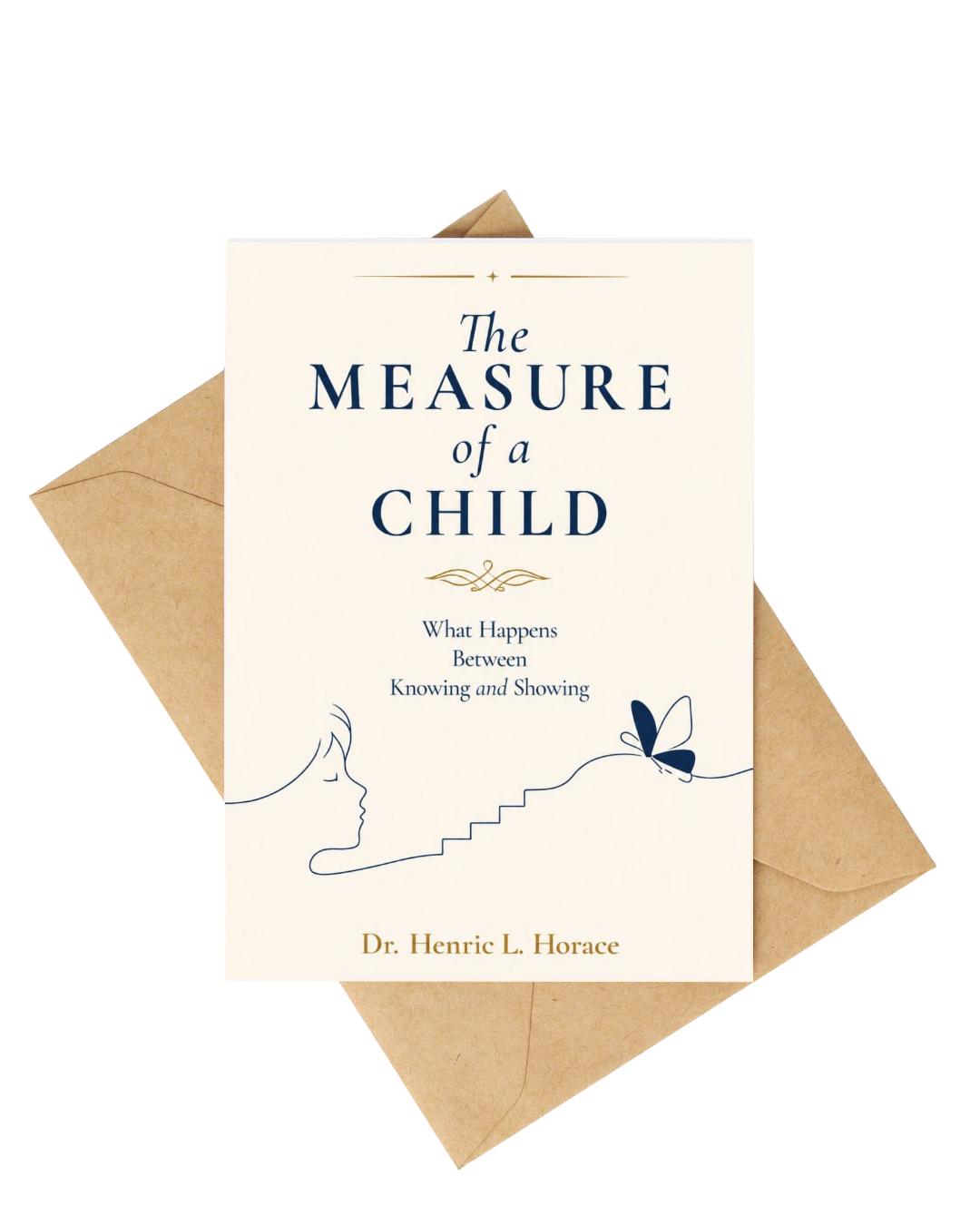
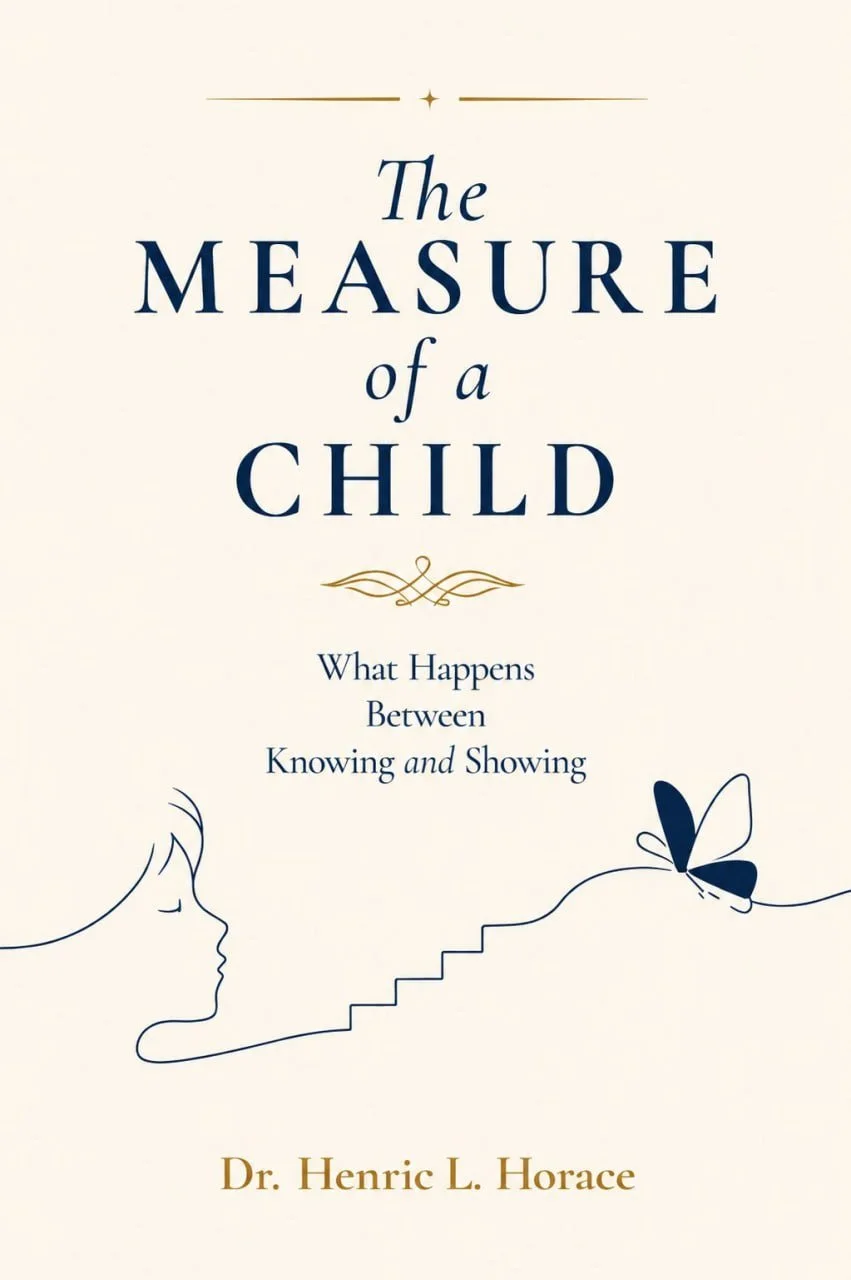
The Measure of a Child
What If We've Been Measuring the Wrong Thing All Along?
Every day, people are measured by what they achieve, what they produce, and how they perform.
But what if performance tells only part of the story?
The Measure of a Child is an invitation to see people differently and to discover what becomes possible when we do.

WHY I WROTE THIS BOOK
One Conversation Changed Everything.
A young man walked into my office carrying his high school diploma.
He looked at me and quietly asked,
"I can't read. Can I take GED classes?"
It broke my heart!
If he had earned a diploma but couldn't read, what exactly had we measured? More importantly, what had we missed?
That question stayed with me.
It changed the way I understood education, performance, and human potential and it became the catalyst of this book.
MAYBE YOU'VE LIVED THIS STORY...
· You knew the answer but couldn't find the words.
· You were judged by one moment instead of a lifetime of potential.
· You began to question yourself because others questioned you.
· You carried burdens no one else could see.
· You wondered if you simply weren't enough.
If even one of these feels familiar, this book was written for you.
MORE THAN A BOOK
This isn't simply a book about education.
It's about children.
Parents.
Teachers.
Leaders.
Workplaces.
Families.
It's about every person who has ever been underestimated and every person who has ever underestimated someone else.
Because every one of us has been measured unfairly.
A DIFFERENT QUESTION
For years we've asked,
"How did they perform?"
Perhaps the better question is,
“What conditions shaped what they were able to access when it mattered most?"
Sometimes changing one question changes everything.
AN INVITATION
I don't expect you to agree with every page.
I simply hope you'll never look at another person's performance the same way again.
Because before we decide what someone is capable of...
We should first understand the conditions that shaped what they were able to show.

-
Why This Chapter Matters
Every day, decisions that shape lives are made in a matter of moments. A student completes an examination. An applicant sits through a job interview. An employee receives a performance evaluation. An athlete takes the final shot. A patient answers a physician's questions. These moments often become more than isolated events; they become judgments about intelligence, competence, motivation, character, and potential. We assume that what people show is an accurate reflection of what they are capable of. It is an assumption so deeply woven into our schools, workplaces, and institutions that we rarely stop to question it.
But what if those moments are telling us something very different?
What if performance is not a direct measure of capacity, but rather the visible outcome of a much larger interaction between knowledge, physiological state, cognitive demand, and environment? What if countless people have been underestimated—not because they lacked ability, but because the conditions surrounding their performance prevented them from accessing what they already knew? This chapter introduces the central premise of the MABEN Framework: Performance is not capacity. It is the foundational idea from which every other concept in this book emerges. Once we begin separating what people know from what they are able to demonstrate in a given moment, we begin asking better questions—not only about education, but also about leadership, hiring, healthcare, justice, parenting, and every human system that relies on performance to make decisions.
Perhaps the most important question is also the simplest:
If performance is not the whole story, what have we been measuring all along?
Read an Exclusive Excerpt
Imagine standing before an iceberg for the very first time. Only a small portion rises above the surface of the water. Beneath it lies something far larger—massive, complex, and almost entirely invisible to the casual observer. No one would claim to understand the iceberg simply by examining what can be seen above the waterline. We instinctively recognize that the greater story exists beneath the surface.
Yet this is precisely how we have learned to measure human beings.
We observe a child's score on a standardized test and infer intelligence. We watch an employee struggle through a presentation and infer competence. We interview a candidate for forty-five minutes and infer leadership potential. We witness a teenager make one poor decision and infer character. Again and again, we mistake what is visible for what is complete.
Performance is visible.
Capacity is not.
The distinction appears subtle, but its consequences are profound. Every institution built around evaluating human performance depends upon the assumption that observable performance faithfully represents underlying ability. Schools assign grades. Employers make hiring decisions. Organizations determine promotions. Courts evaluate credibility. Society distributes opportunity according to what people demonstrate during relatively brief moments in time.
The question is not whether performance matters. Of course it does. Performance has consequences, and outcomes cannot simply be ignored. The more important question is whether performance, by itself, tells the whole truth.
Imagine two students who possess the same understanding of a mathematical concept. One arrives at school well rested, emotionally regulated, physically nourished, and confident. The other arrives exhausted after a restless night, carrying anxiety, hunger, uncertainty, and cognitive overload before the lesson has even begun. They complete the same examination under the same testing conditions.
Their performances differ.
Has their intelligence changed?
Has their capacity changed?
Or have we witnessed something else entirely?
That question transformed the way I began thinking about learning and human performance. Over the years, I watched children explain difficult concepts with remarkable clarity during informal conversations, only to struggle with those very same concepts when faced with an examination. I watched capable adults lose access to knowledge they had demonstrated countless times before. I watched institutions confidently interpret those moments as evidence of limitation, while rarely questioning the conditions under which those performances occurred.
Eventually, I realized that we had been asking the wrong question.
Instead of asking, "What can this person do?" we should first be asking, "Under what conditions were they asked to do it?"
That question became the beginning of MABEN.
A Clarion Moment
The orchestra rose to its feet as the conductor lifted the baton. One by one, the musicians filled the concert hall with sound until the music swelled into something magnificent. Only one violin remained silent.
From the audience, the conclusion seemed obvious. Surely the violinist had forgotten the music, missed her cue, or failed to prepare. No one questioned her ability. No one wondered about the instrument itself.
No one noticed the broken string.
How often do we judge the musician when the problem lies somewhere else entirely?
Pause and Reflect
Think about your own life. Can you remember a moment when someone formed an opinion about your ability based on a single performance? Perhaps it was a disappointing examination, a difficult interview, an important presentation, or a moment when pressure overwhelmed preparation. Did that experience truly define your capacity, or did it simply reflect the conditions surrounding that moment? Now consider another question. How many people around you are carrying labels that began with a single performance rather than a complete understanding of who they are? How many futures have been shaped by conclusions drawn from moments that were never intended to tell the whole story?
Continue the Journey
This preview introduces only the opening idea behind The Measure of a Child. The complete chapter expands this discussion through research, personal experience, and the development of the MABEN Framework, demonstrating why separating performance from capacity may be one of the most important shifts we can make in education, leadership, and human development. When we begin looking beneath the surface of performance, we discover a deeper story—one that has the power to change not only how we measure people, but how we understand them.
Continue reading The Measure of a Child and begin the journey of discovering what happens between knowing and showing.
-
Why This Chapter Matters
Have you ever known the answer but been unable to say it when it mattered most? Perhaps it happened during an examination, a job interview, an important presentation, or even an ordinary conversation. Then, moments later, the answer came effortlessly, leaving you wondering, "How could I know it then and not now?" Most of us have experienced this strange contradiction, yet we rarely stop to ask why it happens. Instead, we often assume the person simply didn't know enough. Schools assign grades, employers make hiring decisions, and organizations evaluate competence based largely on what people are able to demonstrate in a single moment. In doing so, we quietly assume that knowing and showing are the same thing.
This chapter challenges that assumption. One of the most overlooked truths in human performance is that possessing knowledge and accessing knowledge are not identical processes. The ability to demonstrate what we know is shaped by far more than memory alone. Physiological state, cognitive load, emotional demands, and environmental conditions all influence whether knowledge becomes visible or remains temporarily inaccessible. Understanding the difference between knowing and showing changes more than the way we think about learning. It changes the way we think about people.
Read an Exclusive Excerpt
From the time we are children, we are taught that performance reveals learning. If you answer correctly, you understand. If you answer incorrectly, you do not. It is a simple equation, one that has shaped classrooms, workplaces, and institutions for generations. The assumption seems so obvious that we rarely question it. Yet human cognition has never been that simple.
Think about the last time someone asked you a question and your mind suddenly went blank. You knew the answer. You may have known it for years. Yet in that moment, it seemed to disappear completely. Then, while driving home, taking a shower, or lying awake in bed, the answer returned as though it had never left. What changed? Certainly not your intelligence. The knowledge had not vanished from your brain. The difference was not what you knew. The difference was your ability to access what you knew at the moment it was needed.
Knowledge can exist without being immediately available. Just as a library may contain thousands of books that cannot be reached if its doors are locked, the human mind may possess understanding that cannot always be accessed under certain conditions. Stress, fear, cognitive overload, fatigue, distraction, and competing demands can temporarily interfere with retrieval, making it appear as though learning never occurred when, in fact, the knowledge remains intact.
The tragedy is that we often judge people by those moments. A student freezes during an examination and is labeled unprepared. An employee struggles during a presentation and is viewed as less capable than their peers. A child who cannot explain an idea under pressure slowly begins believing they were never intelligent enough to understand it in the first place. Over time, isolated performances become lasting conclusions about ability, and temporary moments of inaccessibility begin shaping permanent identities.
Yet perhaps we have been asking the wrong question all along. Instead of asking, "Did they know it?" perhaps we should first ask, "Were they able to access what they knew when they needed it?" That distinction may appear subtle, but it has profound implications for education, leadership, parenting, and every institution that seeks to measure human capability. The difference between knowing and showing is not merely academic.
It is life changing.
A Clarion Moment
Think about a time when the perfect words came to you...five minutes too late. Long after the conversation had ended, you replayed every sentence in your mind, suddenly knowing exactly what you wished you had said. The knowledge had never been missing. The opportunity to access it had simply passed. Now imagine if someone had judged your intelligence, your competence, or your potential by those few silent seconds. How different might your story have been if that moment had become the measure of who you were?
Pause and Reflect
Can you remember a time when someone assumed you didn't understand simply because you couldn't demonstrate it in the moment? Perhaps you've watched the same thing happen to a student, a colleague, a friend, or someone you love. If knowledge and performance are not always the same, how many people have been underestimated—not because they lacked understanding, but because they lacked access when it mattered most? And how many of us have quietly accepted judgments about ourselves that were based on moments that never told the whole story?
Continue the Journey
The difference between knowing and showing is more than an educational insight. It is a profoundly human one. In The Measure of a Child, this chapter explores the science of access, explains why performance fluctuates even when knowledge remains intact, and reveals how understanding this distinction can transform the way we teach, lead, evaluate, and encourage others. When we stop confusing performance with capacity, we begin to see people differently—and that may be the first step toward changing the systems that shape their lives.
Continue reading The Measure of a Child and discover what happens between knowing and showing.
-
Why This Chapter Matters
Have you ever read the same page three times and realized you couldn't remember a single sentence? Forgotten why you walked into a room? Lost your train of thought during an important conversation, only to remember exactly what you wanted to say minutes later? Most of us dismiss these moments as distractions or signs that we simply weren't paying attention. In reality, they reveal something fundamental about how the human mind works. Our brains are extraordinary, but they were never designed to hold unlimited amounts of information at once. Every demand placed on the mind competes for a limited mental workspace known as working memory. Understanding those limits may be one of the most important steps toward understanding why capable people sometimes struggle to demonstrate what they know when it matters most.
Read an Exclusive Excerpt
One of the greatest misunderstandings about intelligence is the belief that a capable mind should always perform consistently. We admire people who appear to think clearly under pressure and often assume that when someone struggles, they simply lack the necessary knowledge or ability. Yet decades of research in cognitive science tell a different story.
Working memory is often described as the brain's mental workspace. It is where information is temporarily held while we solve problems, make decisions, comprehend language, and connect new ideas to what we already know. Unlike long-term memory, which stores knowledge over time, working memory has limited capacity. It can only hold so much before it begins to lose efficiency.
Imagine trying to complete a jigsaw puzzle on a small table. At first, there is plenty of room to sort the pieces, recognize patterns, and make connections. As more pieces are scattered across the surface, the available space begins to disappear. Eventually, finding the next piece becomes increasingly difficult—not because the puzzle has become more complex, but because there is simply no room left to work.
The human mind functions in much the same way. Every instruction, distraction, worry, emotion, deadline, and decision competes for space within working memory. When that space becomes overloaded, thinking slows, details are forgotten, and problem-solving becomes more difficult. The knowledge may still exist, but access to it becomes increasingly limited.
Now imagine a student sitting quietly in a classroom. Before the lesson even begins, that student's working memory may already be occupied by worries about home, lack of sleep, social pressures, hunger, or fear of making a mistake. By the time the teacher introduces a new concept, much of the student's mental workspace has already been claimed. When the student struggles to answer a question, we often conclude they were not paying attention or lacked the ability to understand. But perhaps the more important question is this:
How much of their working memory was already carrying something else?
Understanding working memory does not lower expectations. It helps explain why expectations alone are not enough. If we ignore the limits of the mind, we risk mistaking cognitive overload for a lack of intelligence. When we recognize those limits, however, we begin designing environments that support learning rather than simply measuring performance.
A Clarion Moment
Revisit the busiest day you've had this year. Your phone kept ringing. Emails continued arriving. Someone interrupted your work every few minutes. You were thinking about a family responsibility while trying to meet a deadline and remember something important before the end of the day. By evening, you forgot something simple—perhaps an appointment, a name, or why you walked into a room.
Did you suddenly become less intelligent?
Or was your mind simply carrying more than it could hold?
Now imagine asking a child to learn algebra, comprehend a novel, or solve a complex problem while experiencing that same level of mental overload every single day.
Pause and Reflect
When was the last time you struggled to think clearly because your mind was simply full? Now consider the students, employees, colleagues, or family members you encounter every day. How often do we interpret moments of overload as moments of inability? And how differently might we respond if we first asked not "What don't they know?" but "What is their mind being asked to carry?"
Continue the Journey
Working memory is more than a concept from cognitive science—it is one of the keys to understanding why performance changes from one moment to the next. In The Measure of a Child, this chapter explores how working memory, cognitive load, and physiological state influence access to knowledge, challenging readers to rethink what they see when they evaluate human performance. Because before we judge what someone can do, we must first understand what their mind is being asked to hold.
Continue reading The Measure of a Child and discover what happens between knowing and showing.
-
Why This Chapter Matters
Few words are used more often in education than rigor, yet few are defined less clearly. We speak of students needing more rigor, schools promoting rigorous instruction, and parents searching for rigorous academic programs. Beneath these conversations, however, lies an important question that is rarely asked: Can rigor truly exist when access is absent?
For generations, educational reform has focused on raising expectations. Higher standards, more demanding coursework, increased accountability, and more challenging assessments have all been introduced with the hope of improving student outcomes. These efforts were well intentioned and, in many respects, necessary. Yet despite decades of reform, countless capable learners continue to struggle—not because they lack intelligence, determination, or potential, but because the conditions required to access what they know have too often been ignored.
This chapter does not argue against rigor. Quite the opposite. It argues that rigor is indispensable. Challenge is essential to growth, and high expectations remain one of the greatest gifts we can offer learners. But rigor should cultivate growth, not confirm failure. When students are repeatedly asked to perform beyond what their current conditions allow them to access, challenge quickly becomes discouragement, and persistence slowly gives way to resignation. The goal is not to make learning easier. The goal is to make learning accessible enough that challenge produces growth rather than defeat.
One of the central principles of MABEN can be summarized in a single sentence:
Rigor without access is frustration.
Read an Exclusive Excerpt
Imagine asking two people to climb the same mountain. Both begin at sunrise. Both are given the same map, the same equipment, and the same expectation of reaching the summit before sunset. From a distance, the challenge appears perfectly fair because the destination is identical. Yet one climber begins carrying nothing more than the supplies needed for the journey, while the other starts the climb with a heavy backpack filled with stones that no one else can see. The mountain has not changed. The route has not changed. The expectation has not changed. Only the conditions have changed. When one climber reaches the summit first, we celebrate perseverance while quietly questioning the effort of the other, rarely considering the invisible burden that shaped the journey from the very beginning.
Education often operates in much the same way. We frequently define rigor by the difficulty of the task rather than by the quality of thinking it invites. More homework, accelerated pacing, increasingly complex assignments, and greater academic demands are often treated as evidence of excellence. Yet difficulty alone has never been the measure of rigor.
True rigor invites learners to wrestle with important ideas, connect concepts across disciplines, solve meaningful problems, defend their thinking with evidence, and persist through productive struggle. It stretches the mind without overwhelming it. It asks students to think deeply while ensuring they possess the conditions necessary for deep thinking to occur.
When access is compromised, however, something very different happens. Students become overwhelmed before they become challenged. Curiosity gradually gives way to anxiety. Persistence is replaced by avoidance, and many eventually conclude that they are incapable of succeeding when, in reality, they have simply been asked to climb while carrying burdens that no one has taken the time to recognize.
This is not an argument for lowering standards. It is an argument for creating the conditions that allow people to meet them. Excellence has never been the enemy.
Inaccessibility has.
A Clarion Moment
Think about a goal that once felt completely beyond your reach. It may have been earning a degree, beginning a new career, recovering from a setback, or simply finding the courage to try again after failing. Now think about the person who stood beside you during that journey. Perhaps they encouraged you when you wanted to quit, challenged you when you doubted yourself, or quietly reminded you of your strengths when you had forgotten them. The goal itself did not become easier. The mountain did not become smaller. What changed was your ability to climb it.
Sometimes the difference between success and surrender is not the height of the mountain.
It is whether someone helped you find your footing before asking you to climb.
Pause and Reflect
Assessed a time in your own life when a difficult challenge ultimately helped you grow. What made that experience transformative? Was it simply the difficulty of the task, or was it the preparation, encouragement, guidance, and opportunity that allowed you to rise to the occasion? Now consider the people you teach, supervise, lead, coach, or parent. Are we merely asking whether they are willing to work hard, or are we also ensuring they have meaningful access to the challenge before them? High expectations are powerful, but they become transformative only when people are given a genuine opportunity to meet them.
Continue the Journey
Rigor should never be confused with difficulty alone. In The Measure of a Child, this chapter explores how neuroscience, cognitive science, and classroom practice converge to redefine what meaningful rigor truly looks like. When access precedes expectation, challenge becomes an invitation to grow rather than a predictor of failure. The result is not lower standards, but a more accurate understanding of how excellence is developed and sustained.
Continue reading The Measure of a Child and discover why the highest expectations become meaningful only when every learner has a genuine opportunity to reach them.
-
Why This Chapter Matters
For decades, schools have searched for interventions that could improve learning, reduce behavioral challenges, and close persistent achievement gaps. New curricula have been adopted, programs implemented, technologies introduced, and countless initiatives launched with the hope of changing outcomes for students. Many have produced moments of progress, yet too often the fundamental question has remained unanswered: What if the greatest intervention is not another program, but the environment in which learning takes place?
This chapter invites readers to rethink the role of schools entirely. Rather than viewing interventions as something delivered only to selected students after difficulties emerge, it explores the possibility that every interaction, every classroom routine, every instructional decision, and every relationship either strengthens or weakens a learner's ability to access what they already know. When a school understands how physiological state, cognitive load, and environmental conditions shape performance, the school itself begins to function as an intervention. Instead of waiting for students to fail before providing support, the entire system becomes intentionally designed to maximize access from the very beginning.
Read an Exclusive Excerpt
Walk into almost any school, and you will find intervention rooms, intervention specialists, intervention schedules, and intervention plans. These resources are often created with the very best intentions, providing additional support to students who have fallen behind academically, socially, or behaviorally. Yet hidden within this approach is an assumption we rarely question: that intervention is something we provide after difficulty has already appeared.
But what if intervention began long before failure?
Imagine entering a school where every classroom is intentionally designed to reduce unnecessary cognitive overload, where transitions are structured to preserve rather than disrupt attention, where educators recognize the difference between inability and temporary inaccessibility, and where students are taught how to recognize and respond to the conditions that shape their own learning. Imagine a school where moments of struggle are treated not as evidence of deficiency, but as opportunities to understand what access requires.
In that kind of environment, intervention is no longer a destination. It becomes the culture.
This does not eliminate accountability, nor does it lower expectations. Students are still challenged to think critically, solve complex problems, and demonstrate mastery. The difference is that the school accepts responsibility for creating the conditions in which those expectations become realistically attainable. High expectations remain, but they are accompanied by high access.
When schools embrace this perspective, something remarkable begins to happen. Discipline conversations become opportunities for understanding rather than punishment alone. Assessment becomes a source of insight rather than merely a record of outcomes. Instruction shifts from delivering information to designing access. Teachers stop asking, "What's wrong with this student?" and begin asking, "What conditions are preventing this student from demonstrating what they know?"
That single question has the power to change an entire school.
The goal has never been to rescue students from challenge. The goal is to remove unnecessary barriers that prevent challenge from becoming growth. When the environment itself becomes intentional, every classroom, every hallway, every conversation, and every adult contributes to the same purpose: creating conditions where human potential has the opportunity to emerge.
Perhaps the most powerful intervention a school can ever provide is not another program.
Perhaps it is becoming the intervention itself.
A Clarion Moment
Think about a place where you immediately felt safe enough to do your best. It may have been a classroom, a workplace, a team, or even someone's home. Before anyone taught you a new skill, corrected your mistakes, or challenged your thinking, something else happened first. You felt welcomed. You felt respected. You felt seen. Without anyone announcing it, the environment quietly gave you permission to think, to take risks, and to grow.
Now imagine if every child walked into school feeling that way every morning.
Sometimes the most powerful intervention is not something we give people.
It is the environment we choose to create around them.
Pause and Reflect
Reflect on the environments that have shaped your own life. Which places brought out your best thinking, your greatest confidence, and your strongest sense of possibility? What made those environments different? Now consider the schools, workplaces, and organizations you influence today. Are people simply expected to succeed within the conditions that exist, or are those conditions intentionally designed to help them succeed? Every environment teaches something. The question is whether it teaches people to doubt their capacity or discover it.
Continue the Journey
When schools become intentional about the conditions that shape learning, intervention is no longer something reserved for a few students. It becomes part of the culture experienced by everyone. In The Measure of a Child, this chapter explores how classrooms, educators, and entire systems can be redesigned around one simple but transformative principle: the condition should never make the decision. When access becomes a shared responsibility rather than an individual burden, schools move beyond reacting to failure and begin cultivating the conditions where success is more likely to occur.
Continue reading The Measure of a Child and discover how changing an environment can change a life—not by lowering expectations, but by creating the conditions where every learner has a genuine opportunity to meet them.
-
Why This Chapter Matters
Every assessment tells a story. A test score, a performance evaluation, a job interview, an observation in the classroom, or even a brief conversation can shape how we see another person's ability. These moments influence admissions, promotions, interventions, opportunities, and expectations. We often trust them because they appear objective, believing they reveal what someone knows or what they are capable of achieving. Yet an assessment is only as meaningful as our understanding of what influenced the performance it measures. If conditions shape access, and access shapes performance, then perhaps the most important question is not simply "How did they perform?" but "What conditions shaped that performance?" This chapter challenges readers to rethink the very purpose of assessment and asks whether our current methods reveal the whole truth—or only part of it.
Read an Exclusive Excerpt
For generations, assessment has been treated as the gold standard of accountability. We test students to measure learning, evaluate employees to measure competence, interview applicants to predict success, and observe professionals to determine readiness. The underlying assumption is remarkably consistent: performance reflects ability. The better the performance, the greater the capability. The poorer the performance, the lower the potential.
But what if that assumption is incomplete?
Imagine taking your temperature with a perfectly accurate thermometer while standing outside on a freezing winter morning. The thermometer faithfully records what it detects. It is not broken. It is doing exactly what it was designed to do. The mistake is not in the measurement—it is in the conclusion we draw from it. Without understanding the conditions surrounding the reading, we risk believing we have measured something permanent when we have merely captured a moment.
Assessment works in much the same way. A score may be accurate. A performance may be real. Yet neither exists apart from the conditions under which it occurred. Fatigue, stress, cognitive overload, environmental distractions, emotional state, prior experiences, and countless other factors influence whether knowledge becomes visible or remains temporarily inaccessible. When we ignore those influences, we unintentionally confuse performance with capacity.
This does not diminish the importance of assessment. It elevates it. The purpose of assessment should never be reduced to sorting people into categories of capable and incapable. Its greater purpose is to understand learning, identify barriers, reveal strengths, and guide growth. A truly meaningful assessment does more than measure outcomes. It helps us understand why those outcomes occurred.
Perhaps fairness is not achieved by lowering standards.
Perhaps fairness begins by asking better questions.
A Clarion Moment
Think about a time when someone formed an opinion about you before they knew your story. Perhaps it happened during an interview, after a single mistake, or because of one disappointing performance. You may have carried that judgment for years, even though it never reflected your true ability.
Now imagine spending your entire education—or your entire career—being measured that way.
How many futures have been shaped by conclusions drawn from moments that were never meant to define a life?
Pause and Reflect
Imagine the people whose lives are influenced by assessment every day. Students waiting for exam results. Employees preparing for annual evaluations. Applicants hoping for acceptance. Children trying to prove they are capable. How often do we accept a score or a performance as the complete story without asking what circumstances may have influenced it? If assessment is meant to reveal understanding, shouldn't it also help us understand the conditions that either supported or limited that understanding?
Continue the Journey
Assessment should do more than assign a number or determine an outcome. It should help us see people more clearly. In The Measure of a Child, this chapter explores how assessment can move beyond measuring isolated performances toward understanding the complex interaction between knowledge, access, and conditions. When we begin asking not only what happened but why it happened, assessment becomes more than an instrument of judgment—it becomes a tool for truth.
Continue reading The Measure of a Child and discover why the most meaningful assessments do more than measure performance—they reveal possibility.
-
Why This Chapter Matters
Every child is born with possibility, yet not every child grows up believing they possess it. Somewhere between our earliest curiosity and our adult identity, many of us begin measuring ourselves by moments that were never meant to define us. A disappointing report card becomes proof that we are not intelligent. A failed interview becomes evidence that we are not capable. A missed opportunity becomes the story we tell ourselves about who we are and what we can become. Over time, isolated performances become enduring identities, and temporary setbacks quietly evolve into permanent beliefs.
But what if those stories were never true?
Throughout The Measure of a Child, one idea has surfaced again and again: performance is not capacity. If that is true, then human potential cannot be understood through performance alone. It must also be understood through access, opportunity, authentic competence, and the conditions that allow people to demonstrate what has been within them all along. This final chapter brings together the science, the stories, and the central ideas of MABEN to explore a question that extends far beyond education and reaches into every corner of human life:
How many lives have been shaped by conclusions that were never meant to become identities?
Read an Exclusive Excerpt
Human potential is often spoken of as though it were a gift that some people receive and others do not. We celebrate those who appear naturally gifted and quietly accept that others simply have less to offer. It is an appealing narrative because it is simple. Unfortunately, it is also incomplete.
Potential is not merely something we possess.
It is something we are allowed to express.
Every experience of authentic competence changes far more than performance. It changes expectation. A child who succeeds at a difficult task approaches the next challenge differently. Confidence slowly replaces hesitation. Persistence begins to replace avoidance. Identity shifts almost imperceptibly from "I hope I can" to "I believe I can." Over time, those experiences become woven into the story people tell themselves about who they are and what they are capable of becoming.
The opposite can happen just as easily.
When children repeatedly encounter moments where stress, fear, cognitive overload, uncertainty, or circumstance prevent them from demonstrating what they know, they often arrive at a painful conclusion. Rather than questioning the conditions surrounding their performance, they begin questioning themselves. A poor grade quietly becomes "I'm not smart." A failed interview becomes "I'm not leadership material." A missed opportunity becomes "People like me don't succeed." Little by little, temporary performances become permanent identities.
The tragedy is not simply that opportunities are lost.
The tragedy is that identities are formed from moments that never reflected the whole person.
This is why MABEN is ultimately about far more than performance. It is about restoring access before people surrender possibility. It is about creating environments where authentic competence can emerge often enough to reshape confidence, identity, and hope. Human potential is rarely revealed in a single extraordinary moment. More often, it emerges through ordinary moments repeated under conditions that allow people to experience success, develop confidence, and discover capacities they never knew they possessed.
Perhaps the greatest measure of a child—or of any human being—is not what they accomplish when everything is easy, but what becomes possible when the conditions no longer stand in the way.
A Clarion Moment
Think about a moment when someone saw something in you before you could see it in yourself. Perhaps it was a teacher who refused to give up on you, a coach who expected more than you thought you could give, a parent who believed in you during your hardest season, or a friend who quietly reminded you of your strength when you had forgotten it. Their belief did more than encourage you. It interrupted a story you were beginning to believe about yourself. In that moment, they did not simply change your confidence. They changed the direction of your future.
Sometimes the greatest gift we give another person is not confidence.
It is evidence that their future is larger than their last performance.
Pause and Reflect
Think about the people whose futures intersect with yours every day. A child sitting quietly in a classroom. A colleague navigating a difficult season. A patient searching for hope. A client trying to rebuild a life. A son, daughter, neighbor, or friend wondering if they are enough. What stories are they beginning to believe about themselves because of the way their performance has been interpreted? More importantly, what role might you play in helping them discover that one difficult moment was never the measure of their capacity? Every interaction carries the possibility of reinforcing a limitation—or revealing a future that has yet to be realized.
Continue the Journey
The Measure of a Child began with a simple challenge: performance is not capacity. It concludes with an even greater invitation. Imagine schools that measure learning without confusing struggle for inability. Imagine workplaces that recognize potential before it becomes obvious. Imagine leaders who ask not only what people accomplished, but also what conditions allowed them to succeed. Imagine a world where access comes before judgment and where human potential is no longer hidden behind isolated performances.
That journey begins with a single decision: to see people not only for what they have shown, but for what they are capable of becoming
Inside the Book
Chapter One
A child studies for hours and fails the test. A student explains a concept perfectly one day and struggles the next. For generations, we have called this inconsistency. This book calls it something else a condition, not a verdict.
Choose How You'd Like to Read It

KINDLE
Instant digital access on any device, right after checkout.
PAPERBACK
The standard edition accessible, portable, and easy to share.

HARDCOVER
A premium keepsake edition, ideal for gifting and display.